Project Documentation
Cloud Email Migration & Operations
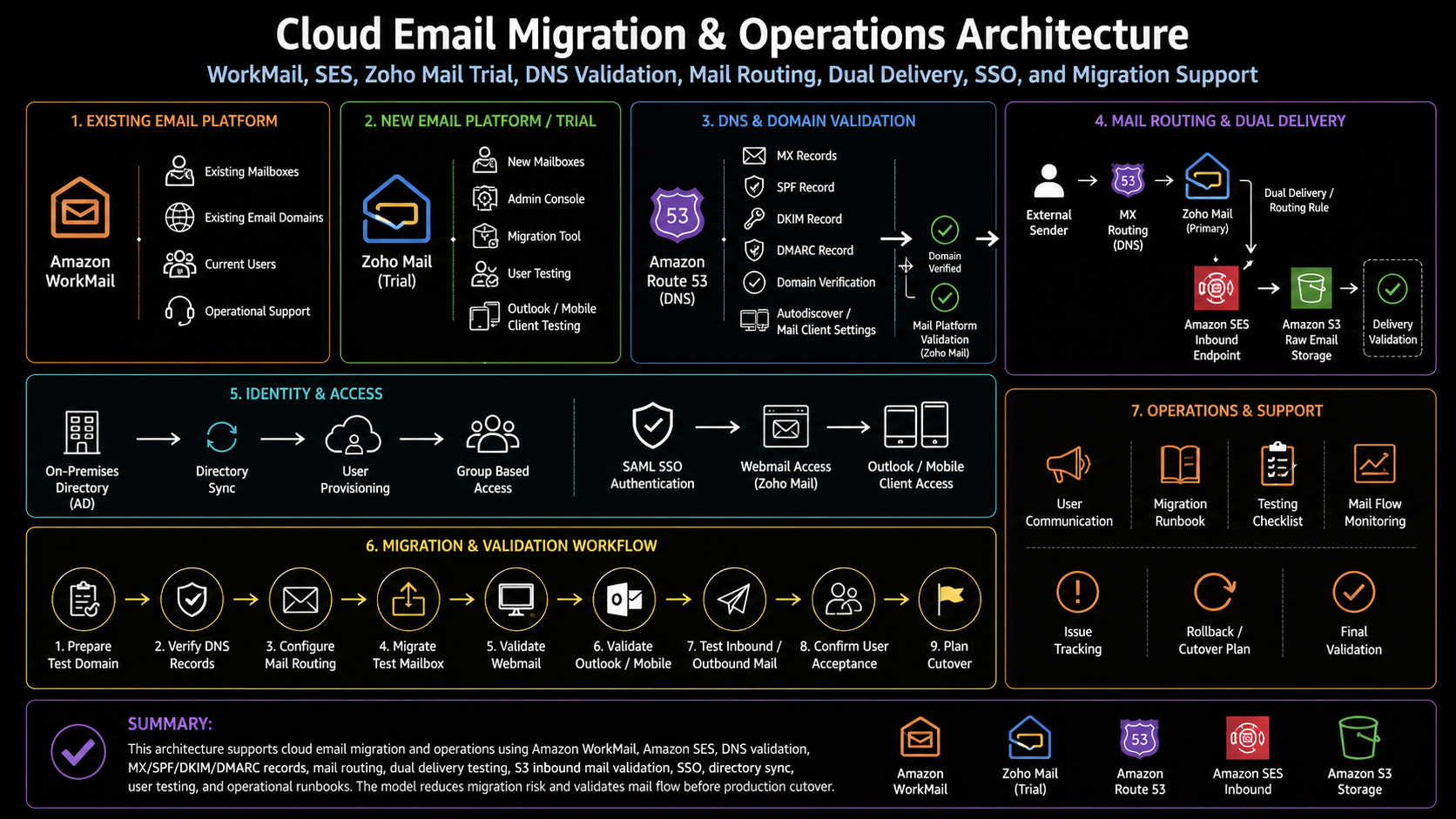
This project documents cloud email migration and mail operations work involving Amazon WorkMail, Amazon SES, Route 53 DNS records, mail routing validation, mailbox migration planning, SMTP credential handling, inbound and outbound mail testing, and user cutover support. The work focused on improving mail platform readiness, reducing migration risk, validating DNS and mail flow before cutover, and creating a repeatable operational process for supporting users during and after the transition.
Overview
This project documents cloud email migration and mail operations work involving Amazon WorkMail, Amazon SES, Route 53 DNS records, mail routing validation, mailbox migration planning, SMTP credential handling, inbound and outbound mail testing, and user cutover support. The work focused on improving mail platform readiness, reducing migration risk, validating DNS and mail flow before cutover, and creating a repeatable operational process for supporting users during and after the transition.
Email migration is more than moving mailbox data from one platform to another. It requires careful coordination across DNS, identity, mail routing, user access, SMTP authentication, certificate or domain validation, client configuration, spam and reputation controls, mailbox migration timing, and production support. This project treated the migration as an operational cloud platform effort, with emphasis on validation, documentation, troubleshooting, and safe cutover planning.
Background
Cloud-based email environments often depend on multiple AWS and DNS services working together correctly. Amazon WorkMail can provide managed mailbox services, while Amazon SES can support sending, receiving, SMTP-based integrations, domain verification, and mail flow testing. Route 53 and public DNS records are required for MX routing, SPF alignment, DKIM signing, DMARC policy, and service verification. If any of these components are configured incorrectly, users may experience mail delivery issues, authentication failures, rejected messages, or inconsistent client behavior.
Migration planning also needed to account for user impact. Mailbox data, aliases, groups, forwarding, SMTP integrations, client access, mobile access, Outlook configuration, and mail routing behavior all needed to be reviewed before moving users to a new platform. A successful migration required both technical readiness and user transition support.
The project focused on creating a safer mail operations model where DNS changes, domain validation, routing tests, SMTP credential updates, mailbox migration steps, and post-cutover troubleshooting were documented and validated before production changes were made.
Business Problem
The business problem was mail platform transition risk. Email is a critical service, and even a small DNS or routing mistake can affect inbound mail delivery, outbound sending, authentication, calendar access, or application-generated messages. Without a clear migration plan, mail flow validation, and rollback awareness, a platform change can quickly turn into a high-impact support issue.
Another challenge was that mail operations often involve both user-facing services and application integrations. Users need mailbox access and a predictable client experience, while applications may rely on SMTP credentials, Amazon SES sending, verified identities, or specific routing behavior. These dependencies have to be identified and validated before cutover so the migration does not break automated mail delivery or business workflows.
The platform need was to create a controlled migration and operations workflow that improved DNS readiness, validated inbound and outbound mail flow, strengthened troubleshooting, reduced operational risk, and provided clearer support steps for users and application owners.
Architecture
The architecture used public DNS as the foundation for mail platform control. Route 53 hosted zones and DNS records supported MX routing, SPF authorization, DKIM signing, DMARC policy, and domain or identity verification. These records determined where inbound mail was delivered, which systems were authorized to send mail, and how recipient systems evaluated message authenticity.
Amazon WorkMail supported managed mailbox operations, including user mailboxes, mailbox access, aliases, and mail platform administration. Amazon SES supported mail sending and receiving workflows, verified identities, SMTP credentials, receipt rules, testing, and application mail integrations. For testing and validation, SES receiving rules could capture inbound messages to Amazon S3 so headers, routing behavior, and delivery paths could be reviewed without relying only on a mailbox client.
CloudWatch supported operational troubleshooting through logs, metrics, alarms, and service-level visibility where available. S3 supported test mail capture and raw message review. SMTP credentials and application mail settings were handled through a controlled process so applications could be updated without exposing sensitive values or relying on informal handoffs.
The overall pattern connected DNS, mail platform services, identity verification, mail routing, application sending, user access, testing, monitoring, and support workflows into one migration operating model. This helped ensure that mail flow was validated before and after cutover.
What I Did
I supported cloud email migration and operations by reviewing DNS requirements, validating Route 53 mail records, checking MX, SPF, DKIM, and DMARC behavior, supporting Amazon WorkMail administration, validating Amazon SES sending and receiving behavior, and helping define the operational steps required for mailbox migration and user cutover.
I also supported inbound and outbound mail flow testing. This included validating that domains or identities were verified, that DNS records were published correctly, that inbound routing followed the expected path, and that outbound messages aligned with SPF, DKIM, and DMARC expectations. When mail flow did not behave as expected, the investigation included DNS lookup results, message headers, SES behavior, WorkMail configuration, CloudWatch logs, and S3-captured test messages.
The work also included operational handoff planning. Mail migrations require coordination with users, application owners, support teams, and administrators. I helped structure the migration process around test validation, cutover readiness, SMTP credential updates, client access checks, post-cutover troubleshooting, and runbook documentation.
Implementation Details
1. DNS readiness review
The migration process began with DNS readiness. Route 53 hosted zones and DNS records were reviewed to confirm that mail-related records were accurate and aligned with the intended mail platform. MX records controlled inbound mail routing. SPF records identified authorized sending services. DKIM records supported message signing and verification. DMARC policy helped define how receiving systems should treat messages that failed authentication checks.
2. Domain and identity verification
Amazon SES and mail platforms often require domain or identity verification before mail can be sent or received reliably. Verification records were created in DNS and then validated through the service console. This step was important because incomplete verification could block sending, prevent DKIM signing, or create inconsistent mail behavior during testing.
3. MX routing and inbound mail flow
Inbound mail flow depended on the correct MX records and routing behavior. During testing, inbound messages were sent from external sources and reviewed to confirm that they reached the intended mail platform or test route. Where SES receiving was used, receipt rules and S3 capture helped confirm that inbound messages were accepted and stored for inspection. This made it easier to validate routing behavior before production cutover.
4. SPF, DKIM, and DMARC validation
SPF, DKIM, and DMARC were reviewed as part of mail security and deliverability readiness. SPF helped authorize sending sources. DKIM helped verify message integrity and domain alignment. DMARC provided policy and reporting behavior for messages that failed authentication. These records were reviewed carefully because incorrect values can affect outbound deliverability or cause legitimate messages to be treated as suspicious.
5. Amazon WorkMail operations
Amazon WorkMail operations included mailbox administration, user access review, alias and group considerations, client configuration, and mailbox migration planning. User readiness depended on more than mailbox creation. Users needed to know how to access mail, what client settings applied, how cutover would affect them, and where to report issues after migration.
6. Amazon SES sending and receiving
Amazon SES supported both application sending and receiving test workflows. Sending required verified identities, approved sending configuration, and SMTP credentials where applications used SMTP authentication. Receiving workflows could use receipt rules to route messages to S3 or other targets for validation. SES helped support both production mail integrations and migration testing.
7. SMTP credential handling
SMTP credentials required controlled handling because they could affect application-generated mail. Credential updates needed to be coordinated with application owners and stored through approved mechanisms. The process required clear communication, validation that applications could authenticate successfully, and a rollback path if a credential update caused mail delivery failure.
8. S3 mail capture and message-header review
S3 mail capture provided a useful validation method for inbound routing and test messages. Captured raw messages could be reviewed for headers, sender, recipient, routing path, authentication results, and delivery behavior. This helped improve troubleshooting because the team could inspect the actual message rather than relying only on user reports or mailbox client behavior.
9. CloudWatch and operational troubleshooting
CloudWatch supported mail operations by helping surface service events, logs, metrics, and troubleshooting signals where available. When mail flow issues occurred, CloudWatch data was reviewed alongside DNS results, SES configuration, WorkMail settings, message headers, and application logs. This helped create a more complete troubleshooting picture.
10. Migration runbooks and cutover planning
Migration runbooks documented the required steps before, during, and after cutover. These included DNS checks, verification records, mailbox readiness, test mail flow, SMTP credential updates, MX record changes, user access validation, monitoring, rollback considerations, and post-cutover support. A documented runbook helped reduce risk during time-sensitive migration windows.
Validation
Validation began with DNS checks. MX, SPF, DKIM, DMARC, and verification records needed to be published correctly and resolvable from public DNS. DNS validation confirmed that mail routing and authentication records were visible before any production cutover took place.
Inbound validation focused on confirming that external messages reached the intended destination. Test messages were sent from outside the environment and reviewed through the mailbox platform or SES receiving path. When S3 capture was used, the raw message was inspected to confirm the sender, recipient, delivery path, authentication results, and receipt behavior.
Outbound validation focused on confirming that users and applications could send mail successfully. This included reviewing SMTP authentication, verified identities, sender alignment, DKIM signing, SPF authorization, and recipient delivery behavior. Application-generated mail needed additional validation because it often depended on stored SMTP credentials or service-specific sending configuration.
Cutover validation included confirming that mailboxes were accessible, messages were delivered correctly, users could sign in through the expected access path, mail clients behaved as expected, and support teams had a clear process for troubleshooting issues. Validation was treated as an operational requirement, not a final optional step.
Operational Workflow
The operational workflow began with discovery and planning. Existing mail domains, DNS records, mailbox dependencies, SMTP integrations, user access requirements, aliases, groups, forwarding behavior, and application sending patterns were reviewed. This helped identify what needed to be migrated, what needed to be validated, and which dependencies could affect cutover.
The next step was platform readiness. Domain verification records were created, SPF, DKIM, and DMARC were reviewed, mailboxes or test users were prepared, SES sending and receiving configuration was validated, and test mail flow was confirmed. This provided evidence that the platform was ready before changing production routing.
Cutover followed a controlled sequence. The current DNS state was reviewed, the approved MX or routing change was applied, DNS propagation was monitored, inbound and outbound mail flow was tested, and user access was validated. Support teams then monitored user reports, message delivery behavior, SMTP integrations, and any application mail failures.
Post-cutover support focused on issue resolution and stabilization. Common troubleshooting areas included incorrect DNS records, stale cached records, SMTP authentication errors, missing aliases, client configuration issues, message delivery delays, SPF or DKIM alignment problems, and application-specific credential updates. Findings were documented and used to improve the runbook for future migrations or mail platform changes.
Outcome
The project improved mail platform readiness by creating a more structured approach to DNS validation, mail flow testing, SMTP credential handling, and user cutover support. Instead of treating migration as only a mailbox move, the process accounted for the full operational path required for successful email delivery and user access.
The work also reduced operational risk by validating MX routing, SPF, DKIM, DMARC, SES behavior, WorkMail access, S3 mail capture, and outbound sending before production changes. This made troubleshooting easier and reduced the chance that unknown dependencies would appear during cutover.
The biggest value was stronger runbook discipline and clearer transition support. The migration process created a repeatable workflow for planning, validating, cutting over, monitoring, and supporting users after the change. This helped improve confidence in mail platform operations and made future email changes easier to manage.
What This Demonstrates
This project demonstrates practical cloud email operations experience across Amazon WorkMail, Amazon SES, Route 53, MX records, SPF, DKIM, DMARC, domain verification, identity validation, inbound and outbound mail flow testing, SMTP credentials, CloudWatch troubleshooting, S3 mail capture, mailbox migration planning, user cutover support, and migration runbooks.
It also demonstrates platform engineering judgment. Email migration requires more than changing MX records. It requires understanding DNS, authentication, mail routing, user access, application sending, credential handling, validation, rollback planning, and operational support. This project shows how those components can be organized into a safer migration model that improves mail platform readiness, strengthens validation, and reduces operational risk.