Project Documentation
DNS & Disaster Recovery Operations
This project documents DNS and disaster recovery operations for AWS-hosted workloads. The work focused on improving DNS control, supporting safer production DNS changes, validating ACM certificate records, maintaining hosted zone visibility, reviewing Route 53 records, and supporting disaster recovery readiness through AWS Elastic Disaster Recovery, recovery runbooks, replication checks, failover planning, and post-recovery validation.
Overview
This project documents DNS and disaster recovery operations for AWS-hosted workloads. The work focused on improving DNS control, supporting safer production DNS changes, validating ACM certificate records, maintaining hosted zone visibility, reviewing Route 53 records, and supporting disaster recovery readiness through AWS Elastic Disaster Recovery, recovery runbooks, replication checks, failover planning, and post-recovery validation.
The project connected two operational areas that are closely related during production support: DNS and recovery. DNS records control how users and systems reach applications, while disaster recovery processes determine how those applications can be restored or failed over when a primary environment is unavailable. The goal was to support a safer operating model where DNS changes, certificate validation, health checks, recovery instances, replication readiness, and failover steps were reviewed and validated before they were needed during an incident.
Background
DNS is one of the highest-risk operational areas in cloud infrastructure because a small record change can affect application access, certificate validation, mail routing, internal service discovery, or recovery traffic. In AWS, Route 53 hosted zones, DNS records, health checks, private zones, public zones, and certificate validation records all need to be managed with clear ownership and production-safe change control.
Disaster recovery has the same requirement for discipline. Recovery is not only about having replicated servers or backups available. It also requires runbooks, launch settings, replication health checks, recovery instance validation, network readiness, security group review, DNS cutover steps, and monitoring after failover. A recovery plan that is not tested or documented creates operational risk because the team may not know exactly what to do when a real outage occurs.
This project supported a practical AWS operations model for both areas. DNS changes were handled with validation and controlled access, while recovery planning used AWS Elastic Disaster Recovery concepts, replication readiness checks, CloudWatch monitoring, and Route 53-based cutover planning to improve recovery readiness.
Business Problem
The business problem was operational risk around DNS changes and recovery execution. DNS records often support production applications, internal services, certificates, mail systems, APIs, and recovery endpoints. If a record is changed incorrectly, deleted accidentally, or not documented clearly, application access can be interrupted and troubleshooting becomes more difficult.
Disaster recovery created a related problem. Replication may be configured, but recovery readiness depends on many details beyond replication itself. Source servers need the correct replication agent, IAM permissions, launch settings, security groups, network paths, and post-launch validation. DNS cutover also needs to be planned so recovered applications can be reached after failover.
The platform need was to create a safer operating model that improved DNS control, clarified production change steps, supported recovery planning, reduced operational risk, and made validation part of the normal process instead of an afterthought.
Architecture
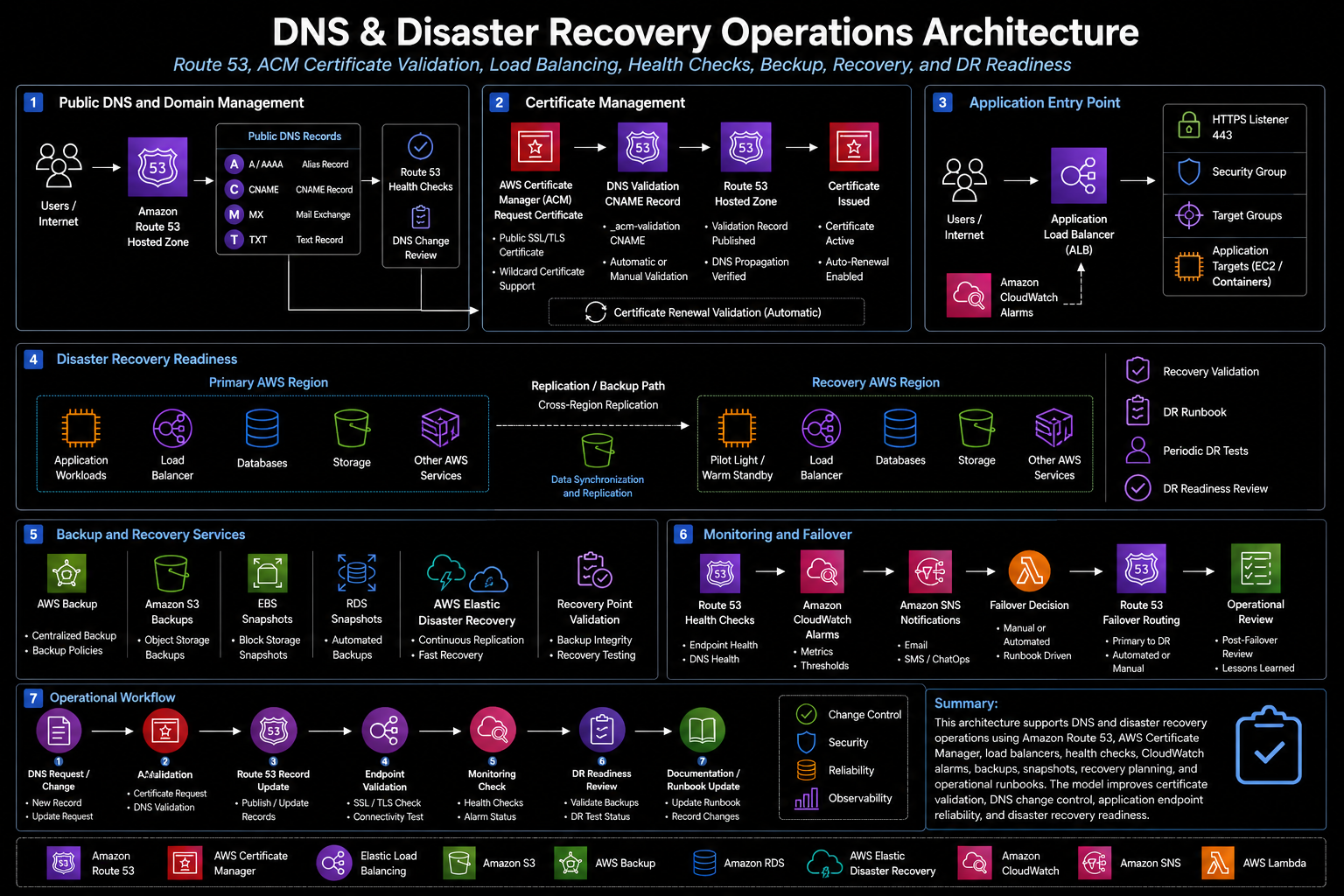
The DNS architecture used Amazon Route 53 as the central DNS service for hosted zones and record management. Public hosted zones supported internet-facing records, while private hosted zones supported internal service discovery where appropriate. DNS records were reviewed for purpose, ownership, routing behavior, and production impact. ACM certificate validation used DNS validation records so certificates could be issued and renewed through controlled Route 53 record creation.
Route 53 health checks and failover routing concepts supported resilience planning. Health checks could be used to monitor endpoint availability, while failover records or planned record updates could support traffic movement during a recovery event. For production-safe operations, DNS changes were treated as controlled changes that required record verification, TTL awareness, rollback planning, and post-change validation.
The disaster recovery architecture used AWS Elastic Disaster Recovery to replicate source servers and prepare recovery instances in AWS. Source servers required the replication agent, the correct IAM permissions, and verified replication status. Recovery settings, launch templates, networking, security groups, instance profiles, and post-launch actions needed to be reviewed before an actual recovery event.
DNS and DRS were connected through the failover process. After a recovery instance was launched and validated, DNS records could be updated to point users or dependent systems to the recovered workload. In more advanced patterns, Systems Manager automation or command documents could support controlled DNS record updates after DRS recovery. This helped make recovery execution more repeatable and reduced the risk of missed manual steps.
What I Did
I supported DNS operations by reviewing Route 53 hosted zones, DNS records, ACM validation records, record ownership, hosted zone access patterns, and production-safe DNS change steps. This included validating whether certificate validation records were created correctly, confirming records resolved as expected, reviewing DNS change impact, and helping ensure changes were completed through the correct access path and change process.
I also supported disaster recovery operations by reviewing AWS Elastic Disaster Recovery readiness, source server registration requirements, replication status, launch settings, recovery planning, and validation steps. The work required understanding how replication agents, IAM instance profiles, source servers, recovery instances, networking, security groups, CloudWatch metrics, and DNS cutover steps fit together during a recovery workflow.
The project also involved runbook discipline. DNS and recovery work needs clear documentation because these activities often happen during urgent support windows or planned change events. I helped organize the process around repeatable steps: review the current state, make the approved change, validate DNS or replication behavior, document the result, and preserve rollback or recovery guidance.
Implementation Details
1. Route 53 hosted zone review
Route 53 hosted zones were reviewed as the starting point for DNS control. The review focused on which hosted zones existed, whether they were public or private, what records they contained, and which records supported production, internal services, certificates, or recovery workflows. This helped improve DNS visibility and made it easier to understand the operational impact of record changes.
2. DNS record management
DNS records were treated as production infrastructure. Record changes required checking the current value, confirming the requested value, understanding TTL behavior, identifying the application or service supported by the record, and validating resolution after the change. This reduced DNS change risk and made troubleshooting easier when records did not behave as expected.
3. ACM certificate validation
ACM certificate workflows required DNS validation records in Route 53. Certificate validation depended on creating the correct CNAME records for the requested domain and any wildcard names. After the records were created, validation required confirming that ACM moved from pending validation to issued and that the record remained available for future renewal eligibility.
4. Health checks and failover routing concepts
Route 53 health checks and failover routing concepts were part of the resilience model. Health checks can support endpoint monitoring, while failover records or planned DNS updates can support traffic movement during an outage or recovery event. The review process considered how DNS would be changed, who would approve the change, what TTL should be expected, and how application access would be validated after failover.
5. DNS backup and recovery readiness
Hosted zone records and DNS configuration were considered part of recovery readiness. DNS records are often required to restore application access after an outage, so having a clear view of hosted zone contents, record purpose, and recovery-related DNS steps helped strengthen recoverability. DNS backup or export patterns also supported safer recovery and review by preserving a reference point for important records.
6. AWS Elastic Disaster Recovery source server setup
AWS Elastic Disaster Recovery depended on registering source servers with the replication service. This required installing the replication agent, confirming the instance profile had the required permissions, and validating that the source server appeared in the DRS console. Registration alone was not enough; replication health, launch settings, and recovery configuration also needed to be reviewed.
7. Replication readiness review
Replication readiness was validated by checking whether source servers were replicating successfully and whether any replication errors needed follow-up. CloudWatch metrics and DRS status views supported ongoing review. The goal was to identify replication problems before a real recovery event, not during one.
8. Recovery instance and launch settings
DRS launch settings needed to be reviewed so recovery instances would start with the expected instance type, subnet, security groups, instance profile, storage configuration, and network behavior. Recovery testing needed to confirm that the launched instance was reachable, that application services started correctly, and that required monitoring and access controls were present.
9. DNS cutover planning
DNS cutover planning connected the recovery instance to the application access path. After recovery, Route 53 records may need to be updated to point to a recovered instance, load balancer, or private IP address. Cutover planning included record identification, current value review, target value confirmation, TTL awareness, validation commands, and rollback steps.
10. CloudWatch monitoring and alarms
CloudWatch supported both DNS-adjacent operations and disaster recovery readiness. Metrics, logs, and alarms helped identify health issues, replication problems, endpoint failures, or post-recovery application concerns. Monitoring was important because recovery is not complete until the restored workload is operating and observable.
Validation
DNS validation focused on confirming that records existed, resolved correctly, and supported the intended application or certificate workflow. For ACM validation, this meant confirming that the DNS validation record was present and that the certificate moved to an issued state. For production records, validation meant confirming the current record value, checking DNS resolution, testing the application endpoint where appropriate, and documenting the final state.
Disaster recovery validation focused on readiness before failover and functionality after recovery. Before failover, source servers needed healthy replication status, correct permissions, reviewed launch settings, and no unresolved replication errors. After recovery, validation included confirming the recovery instance launched, the operating system and application services were available, network access worked as expected, CloudWatch monitoring was active, and DNS could be updated or validated according to the runbook.
Change validation also included rollback awareness. For DNS changes, this meant knowing the previous record value and how to restore it if needed. For recovery operations, this meant understanding when to continue with failover, when to stop and investigate, and how to document post-test or post-incident findings for follow-up.
Operational Workflow
The operational workflow for DNS began with request review. The requested record, domain, hosted zone, record type, current value, new value, TTL, and business purpose were reviewed before making changes. For certificate validation, the ACM-provided DNS validation records were created in the appropriate hosted zone and then validated through ACM and DNS lookup results.
For production DNS changes, the workflow followed a controlled sequence: review the current record, confirm approval, make the change, validate DNS resolution, test the application path, document the change, and preserve rollback details. This helped reduce operational risk and made it easier to troubleshoot if users or systems reported access issues after a DNS update.
The disaster recovery workflow began with readiness review. Source servers were checked for DRS registration, replication health, launch configuration, network settings, and required IAM permissions. Recovery testing then involved launching recovery instances in a controlled way, validating operating system and application availability, checking monitoring, and confirming whether DNS changes would be required for application access.
During a failover or recovery test, the workflow moved from infrastructure recovery to access validation. Once the recovery instance or target endpoint was available, DNS records could be updated according to the runbook. After DNS propagation and endpoint validation, the recovered workload was monitored through CloudWatch and any issues were recorded for remediation or runbook improvement.
Outcome
The project improved DNS control by treating Route 53 records, ACM validation records, hosted zones, and DNS changes as production infrastructure that required review, validation, and documentation. This reduced operational risk and made DNS troubleshooting more structured.
The work also improved recovery readiness by connecting DRS replication, recovery instance launch settings, monitoring, DNS cutover planning, and validation into a clearer operating model. Recovery planning became more practical because it accounted for the steps required after an instance was recovered, including network access, application validation, monitoring, and DNS updates.
The biggest operational value was stronger runbook discipline. DNS and disaster recovery activities are time-sensitive and high impact, so having repeatable steps, validation checks, and rollback awareness helped improve confidence in production changes and recovery planning.
What This Demonstrates
This project demonstrates practical AWS operations experience across Route 53, hosted zones, DNS records, ACM certificate validation, Route 53 health check and failover concepts, AWS Elastic Disaster Recovery, replication readiness, recovery instances, Systems Manager-based recovery actions, CloudWatch monitoring, production-safe change management, and operational runbooks.
It also demonstrates platform engineering judgment. DNS and disaster recovery work require more than knowing which console page to open. They require understanding access paths, certificate validation, TTL behavior, routing impact, recovery dependencies, replication health, network configuration, monitoring, rollback planning, and stakeholder communication. This project shows how those pieces can be organized into a safer operating model that improves DNS control, strengthens recovery readiness, and reduces operational risk.